The Instrument and the Substrate
Why the Archive Computes Its Optics Only When Asked — GPU Shading as Curatorial Practice
A shader whose parameters cannot cite their source is decoration; a shader whose failure the visitor can perceive is a defect. The instrument earns its place only when the archive supplies its physics and the substrate absorbs its absence.
Read the abstract
The web's creative-coding tradition treats the GPU as an atmosphere: shaders run everywhere, always, over everything. This monograph argues the opposite discipline. In an archival interface, CSS is the substrate — permanent, legible, cheap — and GPU shading is an instrument: mounted on a declared specimen surface, parameterized from the archive's own catalogued coefficients, and dismounted the moment the reader, the device, or the frame budget asks. The essay documents the engineering doctrine behind the Chromologium's optical instruments and defends gating as an act of curation rather than a concession.
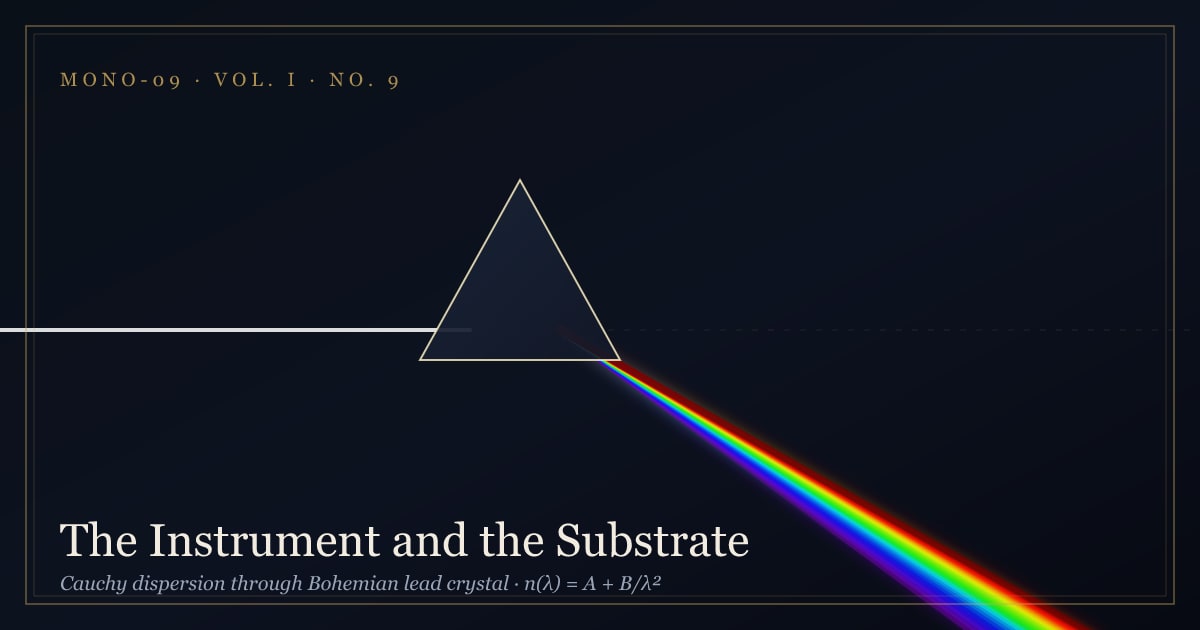
Inspect the archival plate
I. The Substrate Doctrine
Every page of this archive is complete before a single GPU program compiles. Typography, palette strips, friction gauges, and the frosted telemetry rail are set in CSS — the substrate — and the substrate is never a placeholder. This inverts the habit of the shader-demo tradition, in which the canvas is the page and its loss is a blank rectangle. Here the loss of an instrument is designed to be imperceptible: the plate beneath it was always finished.
The doctrine has a mechanical corollary: instruments must be permitted to die. The optical engine carries a one-way degradation ladder — a lost WebGL context, a failed compile, or a sustained frame cost past twenty milliseconds each retire the instrument for the session and return the surface to its static state, permanently and without ceremony. No retry loops, no spinners. An instrument that cannot fail invisibly was never an instrument; it was a hostage.
Gating is therefore not a performance apology but the curatorial position. A museum does not run its centrifuge in the reading room. It keeps the reading room quiet and brings a visitor to the bench when the visitor asks to see the experiment run.
☞An instrument that cannot fail invisibly was never an instrument; it was a hostage.
II. Parameters With Provenance
What separates an optical instrument from a lens flare is where its numbers come from. Every sovereign entry in the Design Atlas now carries a numeric optics block — scattering depth, micro-facet roughness, specular anisotropy, metalness, refractive index at the sodium D line, and a patina accumulation rate — authored against published material constants: calcite marble near n = 1.56, Bohemian lead crystal at 1.66, silk fibroin at 1.54. When the Carrara plate glows at its limb and the urushi plate does not, the difference is a row in the archive, not a mood in the art direction.
The pigment bath obeys the same rule. Mixing coefficients are not invented; they are inverted from each pigment's catalogued masstone through the Kubelka–Munk relation K/S = (1 − R)² / 2R, the two-constant scattering model that has anchored industrial color practice since 1931 and computer-generated watercolor since Curtis and colleagues demonstrated it in 1997. Gold stirred into Klein blue turns the compromised green of a real palette because the mathematics of turbid media says it must.
This is the archive's structural advantage over any component library: the parameters were already here. The same row that voices a nation's earcon frequency and its palette's APCA scores now drives its plate's subsurface glow. Provenance is not a caption on the shader — it is the shader's input.
Read a surface three ways
Keep one folded sheet in view. Compare its flat colour, a movable light, and the parameters used to draw it.
The authored optics block consumed verbatim by the atlas material plate.
| scatterDepth | 0.65 |
| roughness | 0.15 |
| anisotropy | 0.05 |
| metalness | 0.00 |
| ior | 1.56 (calcite, 589 nm) |
| patinaRate | 0.08 / century |
III. One Context, Many Windows
Browsers cap live WebGL contexts near a dozen and evict the eldest without appeal, which is why a page of independent canvas widgets is a page that eventually crashes itself. The Chromologium runs one context on a detached canvas. Each instrument registers a rectangle; the engine renders visible rectangles into scissored viewports and blits each region into that surface's own two-dimensional canvas within the same frame.
The blit is not a compromise — it is what preserves the site's compositing model. Backdrop filters, blend modes, and scroll-linked reveals continue to layer exactly as the substrate intends, because every instrument remains an ordinary DOM node rather than a hole punched through the stacking order by a full-viewport underlay.
The loop itself is parsimonious: it runs only while an instrument intersects the viewport, suspends when the tab hides, halves its backing resolution under frame-budget pressure, and disarms entirely on constrained hardware. The reader pays for optics precisely while looking at optics.
IV. Restoration as the Default State
The preference spine resolves in strict order: the operating system's reduced-motion contract outranks the site's own switch, which outranks the device heuristics. A visitor who has asked their machine for stillness receives the full archive, still. This ordering is printed into the engine rather than the style guide, because an accessibility promise enforced by convention is a promise already half-broken.
The chrono-degradation scrubber follows the same ethic in miniature. It ages iron-gall fades, cellulose foxing, and craquelure into the reproduction plate — never into the living document. The text of a monograph is not a specimen; it is the reading room. Only the framed plate on its wall may be weathered, and the scrubber's rightmost stop is not decay but restoration.
This, finally, is the thesis the archive publishes to its machine feeds without embarrassment: CSS is the substrate; GPU passes are opt-in instruments on declared surfaces, sharing one context, dying quietly, and citing their coefficients. The claim survives contact with the source code — which is the only kind of claim an archive should make.
Put the argument to work.
Keep material settings attached to the specimen as it moves between a preview and a workbench. Include a restore action and a visible explanation of authored values.
A useful boundary. This diagram uses an authored shading model, not measured fabric optics. A convincing rendering alone cannot establish material provenance.
Continue in the laboratorySources & further reading.
The books and papers behind the argument, with curatorial notes and references formatted in APA 7th edition. The citation style identifies the source; it does not claim external peer review.
Kubelka, P., & Munk, F. (1931). Ein Beitrag zur Optik der Farbanstriche [An article on the optics of paint layers]. Zeitschrift für technische Physik, 12, 593–601.
Why it belongs here The two-constant scattering and absorption model of turbid media; the mathematical core of every pigment mixture computed in LAB-08.
Curtis, C. J., Anderson, S. E., Seims, J. E., Fleischer, K. W., & Salesin, D. H. (1997). Computer-generated watercolor. In Proceedings of the 24th annual conference on computer graphics and interactive techniques (SIGGRAPH '97) (pp. 421–430). ACM. https://doi.org/10.1145/258734.258896
Why it belongs here Demonstrated Kubelka–Munk inversion from masstone reflectance for digital paint — the exact K/S = (1 − R)²/2R derivation the bath employs.
Newton, I. (1704). Opticks: or, a treatise of the reflexions, refractions, inflexions and colours of light. Smith & Walford.
Why it belongs here The prism decomposition experiments underlying LAB-07's dispersion bench and its spectral fan.
Cauchy, A.-L. (1836). Mémoire sur la dispersion de la lumière [Memoir on the dispersion of light]. J. G. Calve.
Why it belongs here Source of the empirical dispersion relation n(λ) = A + B/λ² that parameterizes every glass preset on the optical bench.
Ottosson, B. (2020). A perceptual color space for image processing. https://bottosson.github.io/posts/oklab/
Why it belongs here Defines the OKLab/OKLCH space and conversion matrices used by the token bridge that feeds live design tokens into shader uniforms.
Archival Cross-References
Related Lexicon Definitions
Computational Patina
The systematic engineering of organic material wear, edge attenuation, and surface memory into digital design ...
Inspect Definition →OKLCH Perceptual Lightness Invariance
A cylindrical color space mathematically mapped to human visual perception where changes in hue or chroma do n...
Inspect Definition →Related Design Atlas Cartography
Japan
Ma (間) — Negative Space — Emptiness is not absence; it is the interval that gives meaning to form.
Explore Country Atlas →Italy
Rinascimento — Renaissance Humanism — The human body is the measure of all proportion; architecture must answer to the eye before the blueprint.
Explore Country Atlas →Archival Inquiries: The Instrument and the Substrate
Bespoke recursive search tree answering core questions on The Instrument and the Substrate.