
Musée Carnavalet, Paris · P2358
MONO-01VOL. I · NO. 1
Game Design & LudologyDiegetic Ludology, Tangible Fiction, and the Rejection of the Sterile Overlay
☞When an interface ceases to be a detached heads-up overlay and becomes physical matter within the world, user cognitive load transforms from synthetic decoding into direct spatial intuition.
We have somehow accepted that the most critical instruments in our digital lives should feel like laminated stickers floating over the thing we are actually doing. By interrogating the spatial mechanics of diegetic game design—where health monitors live on physical spine rigs and inventory manifests as folded parchment—this monograph outlines an architectural doctrine for software where interface elements cease to be detached heads-up chrome and become situated matter with mass, friction, and spatial consequence.
DOCUMENTED3 sourcesINTERPRETEDcuratorial reading

The Metropolitan Museum of Art, New York
MONO-02VOL. I · NO. 2
Literary ArchitectureBorgesian Taxonomies, Marginalia, and the Infinite Catalog as Design System
☞A design system is not a set of components; it is a combinatorial syntax. Tokens are grammar, components are vocabulary, and an interface is a sentence that must parse coherently under load.
I keep thinking design systems have been described incorrectly. They are not collections of reusable UI components; they are combinatorial grammars. By uniting the writer's understanding of syntax with the software engineer's discipline of state, this monograph establishes the literary architecture of computing: components are vocabulary, tokens are grammar, interfaces are sentences, and products are literature produced under constraints. Borges, Calvino, Eco, and medieval rubricators enter not as decorative citations, but as Exhibit A in the defense of systematic spatial prose.
DOCUMENTED4 sourcesINTERPRETEDcuratorial reading

Bodleian Library, University of Oxford
MONO-03VOL. I · NO. 3
Material PhilosophyComputational Patina, Material Memory, and the Necessity of Aging Software
☞A surface that cannot record wear cannot record human devotion. Without entropy, there can be no heirloom.
Why do we treasure the softened cloth spine of an old notebook, the polished depression in an ancient stone threshold, or the warm brass patina on an instrument's focus ring, yet treat the slightest evidence of wear in software as technical debt? Digital interfaces exist in a pathological state of clinical, immortal brand-newness—and are therefore permanently disposable. This monograph proposes the discipline of Computational Patina: embedding material memory, diurnal entropy, and substrate bleed into digital tokens so that software can accumulate the dignity of having been lived in.
DOCUMENTED3 sourcesINTERPRETEDcuratorial reading

Archival Architectural Collection
MONO-04VOL. I · NO. 4
Acoustic ErgonomicsAcoustic Ergonomics, Physical Foley Synthesis, and Aural Architecture in Digital Instruments
☞An interface that is visually exquisite but sonically sterile is an amputated instrument. When acoustic feedback is modeled after physical material collisions, operator confidence transforms from nervous visual checking into tactile certainty.
We design digital interfaces as though human beings were disembodied eyeballs floating in silence. Yet in physical space, sound is how we perceive enclosure, proximity, material density, and confirmation before our eyes even finish focusing. Contemporary software has reduced sound to piercing notification chimes and juvenile electronic chirps that users promptly mute in self-defense. Drawing from R. Murray Schafer's soundscape ecology, Barry Blesser's aural architecture, and William Gaver's auditory icons, this monograph establishes a discipline of acoustic ergonomics for spatial software.
DOCUMENTED3 sourcesINTERPRETEDcuratorial reading

Archival Architectural Collection
MONO-05VOL. I · NO. 5
Cognitive ErgonomicsIn Praise of Deliberate Friction, Mindful Ergonomics, and Instrumental Agency
☞Bad friction obstructs; designed resistance communicates consequence. When software eliminates all resistance, it eliminates the tactile medium through which human intention is calibrated into mastery.
For twenty years, digital product culture has treated friction as an unmitigated defect to be eradicated in the name of transactional velocity. But efficiency is not agency. The highest-precision physical instruments in human history—Leica focus rings, Steinway key actions, and surgical calipers—are never frictionless; they are engineered with calibrated mechanical resistance to foster deliberate human judgment. This monograph articulates the crucial distinction between obstruction and designed resistance: bad friction gets in your way; designed resistance communicates consequence and enables mastery.
DOCUMENTED3 sourcesINTERPRETEDcuratorial reading

Archival Architectural Collection
MONO-06VOL. I · NO. 6
Nomography & Instrumental SystemsNomography, Slide Rules, and Proportional Geometry in Modern Design Systems
☞A design token is not an isolated variable; it is a point on a continuous multi-dimensional nomogram. When we design systems as alignment charts rather than static dictionaries, proportions remain coherent across any scale.
While building token architectures, I realized we were treating design tokens like static values when they are really multi-dimensional mathematical relationships. Long before microprocessors, engineers solved complex multi-variable equations using nomograms—graphical alignment charts where laying a straightedge across graduated scales solved multi-dimensional physical problems at a glance. By reviving Maurice d'Ocagne's 1899 nomography, this monograph reframes design tokens as living geometric nomograms that preserve harmonic proportion across typography, space, and color.
DOCUMENTED3 sourcesINTERPRETEDcuratorial reading

Archival Architectural Collection
MONO-07VOL. II · NO. 1
Color Science & Chromatic TheoryPerceptual Lightness, Display P3 Gamut Boundaries, and the Limits of Deterministic Contrast
☞Perceptual lightness is not an aesthetic preference; it is a calibrated model of human cone photoreceptors. But perceptual lightness is not a contrast score—and making that distinction is where real color engineering begins.
For thirty years, digital color in software was trapped in the non-linear distortion of sRGB and HSL, where pure yellow appeared nine times brighter than pure blue at the same nominal lightness. The web's transition to OKLCH establishes perceptual lightness uniformity and unlocks Display P3 wide-gamut vibrance. But blind faith in formulas has created a new myth: that OKLCH lightness guarantees contrast and accessibility by itself. This monograph clarifies the physics of perceptual lightness versus photometric luminance, explains why L is not an APCA contrast score, and documents how to engineer dual-mode design systems that respect human vision rather than cathode-ray tube legacy.
DOCUMENTED1 sourcesINTERPRETEDcuratorial reading

Archival Architectural Collection
MONO-08VOL. II · NO. 2
Temporal ArchitectureEngineering digital interfaces that breathe with real-world solar time, ambient light, and domestic rhythms.
☞An interface that knows what time it is behaves like architecture, not like an appliance. Software should not be an artificial sensory vacuum; it should breathe with the astronomical passage of diurnal time.
Binary themes—the blunt toggle between blinding white Light Mode and stark black Dark Mode—treat digital software as an artificial sensory vacuum cut off from the physical world. An interface that knows what time it is behaves like architecture, not like an appliance. This monograph establishes the engineering doctrine of Diurnal Experience Architecture: continuously modulating color temperature, contrast elasticity, typographic weight, and information density in synchrony with solar elevation, seasonal light, and human domestic rhythms, governed by an uncompromising user override contract.
DOCUMENTED1 sourcesINTERPRETEDcuratorial reading
The Chromologium Archive
MONO-09VOL. I · NO. 9
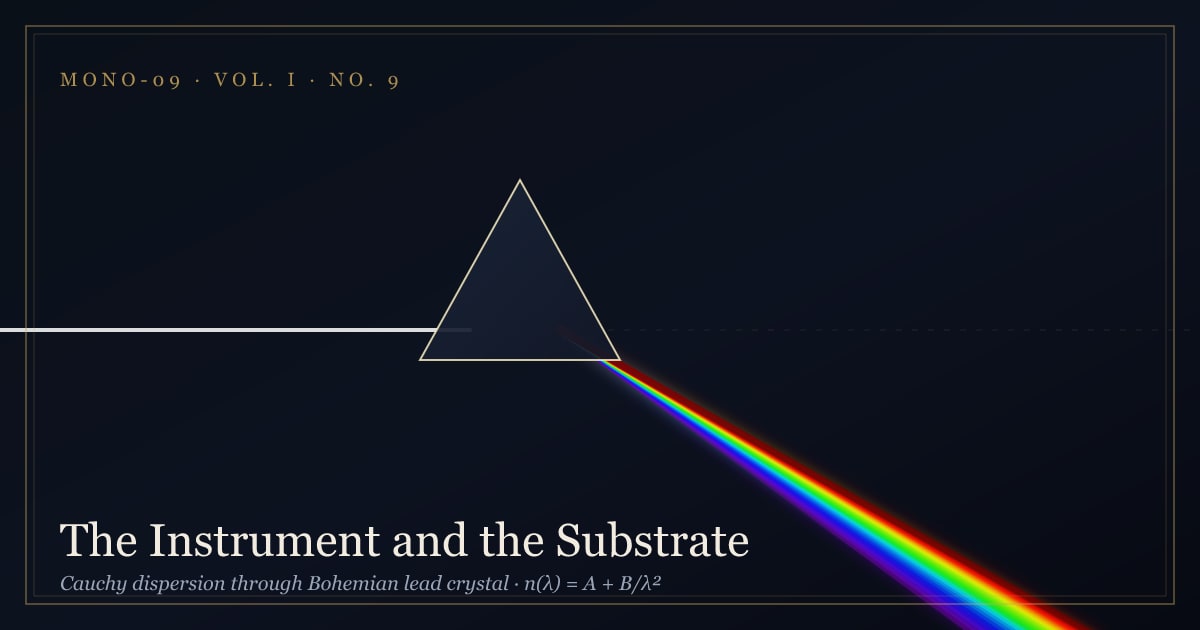
Temporal ArchitectureWhy the Archive Computes Its Optics Only When Asked — GPU Shading as Curatorial Practice
☞A shader whose parameters cannot cite their source is decoration; a shader whose failure the visitor can perceive is a defect. The instrument earns its place only when the archive supplies its physics and the substrate absorbs its absence.
The web's creative-coding tradition treats the GPU as an atmosphere: shaders run everywhere, always, over everything. This monograph argues the opposite discipline. In an archival interface, CSS is the substrate — permanent, legible, cheap — and GPU shading is an instrument: mounted on a declared specimen surface, parameterized from the archive's own catalogued coefficients, and dismounted the moment the reader, the device, or the frame budget asks. The essay documents the engineering doctrine behind the Chromologium's optical instruments and defends gating as an act of curation rather than a concession.
DOCUMENTED5 sourcesINTERPRETEDcuratorial reading