The Work of Translation
Origins, judgement, and meaning in an age of instant production
A surface with a past
A wine-dark field sits beside pale stone and green copper. In a few moments it can become a palette, a landing page, a dozen variations of a familiar interface. The speed is remarkable. Yet the resulting surface may tell us almost nothing about why these things were brought together. It may preserve their colours while losing the relationship that made someone look at them in the first place.
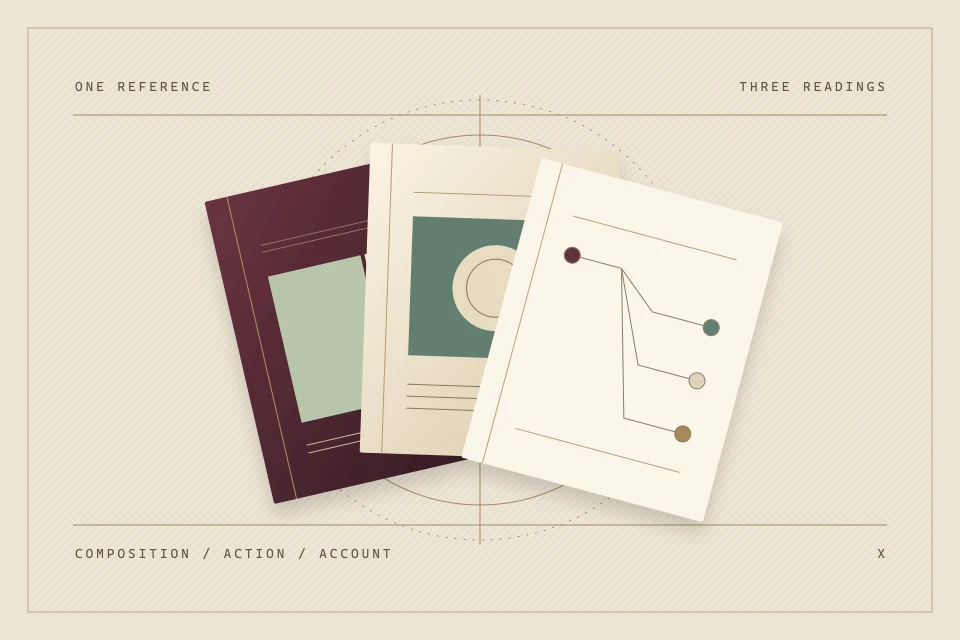
Three folios introduce three interpretations of one reference: composition, action and account. The working figure makes their choices and omissions explicit.
Edition record Thesis, abstract, sources & revision
Making something quickly does not make it meaningless. Meaning depends on the relationships we understand, the choices we make, and the responsibilities we carry into the result.
Read the abstract
When images and interfaces can be made quickly, their abundance does not settle what they mean. This essay proposes translation as a practice of accountable selection: identify a reference, explain the relationship being carried forward, and make the losses and new decisions visible. Wine & Verdigris supplies one authored reference for three interface interpretations. UNESCO’s account of living heritage establishes an important boundary around cultural claims, while PROV-O and C2PA clarify what a technical provenance record can—and cannot—establish.
Editorial essay; not externally peer reviewed. Estimated at 200 words per minute for the abstract and main prose; references and interactive studies take additional time.
Revised 2026-11-04. New closing essay for Volume I. AI-assisted editorial draft prepared for author review. Primary sources distinguish living heritage, provenance and the author’s proposed design practice; no claim of community endorsement or historical reconstruction.
That is the question I want the Chromologium to keep open. When an image is easy to produce, what makes this particular image worth attending to? I do not think difficulty is a sufficient answer. A slowly made object can be careless about its sources; a quickly made sketch can reveal a precise and generous observation. Effort can be part of a work’s history without being a reliable measure of its meaning.
The Wine & Verdigris study offers a small place to begin. It is an authored material composition, not documentation of an excavated room or a historical workshop. Its relationship between depth, weathered colour and pale relief can still be examined. The task is to say what we noticed in that relationship, what we chose to carry into an interface, and what the interface cannot carry with it.
Origins are relationships
An origin is more than a date attached to a pleasing object. A material may connect to a place, a method, a trade, a ritual or a dispute. A belief may have living participants who disagree about its interpretation. Treating all of these as a common stock of visual motifs erases differences that a careful study ought to preserve. The first act of translation is therefore deciding what kind of reference we are actually dealing with.
UNESCO’s 2003 Convention describes intangible cultural heritage as practices and knowledge recognised by the communities concerned, transmitted and continually recreated. It does not define heritage as a frozen appearance available for anyone to certify. Its ethical principles place those communities in a primary role and emphasise dialogue and informed consent. These are principles for safeguarding living heritage, not a ready-made licence for an interface designer.
For this project, I take that distinction as a limit on my own authority. I can explain an observation, identify a source and propose a contemporary interpretation. I cannot make a study culturally authoritative by giving it a solemn title. Where a reference concerns a living practice, the question is also whose account is present, whose interests are affected, and whether the proposed use should happen at all. Some relationships require conversation; some are not mine to translate.
One reference, three interpretations
The figure holds one authored reference steady while changing the design intention. The first reading treats its colours and contrast as a composition. The second asks how the relation between a deep field and a pale object might organise an action. The third makes a source-and-decision record prominent. None is a complete translation of the reference, and the third does not become truthful merely because it looks documentary.
Inspect figure 01 ↓What travels from the reference?
Compare three interpretations of Wine & Verdigris, then record the relationship you would carry forward.

A place for light.
- Preserves
- The contrast between a wine-dark field, pale stone and green copper.
- Changes
- Material relationships become a flat hierarchy of colour and space.
- Leaves behind
- Weight, temperature, material process and any claim of historical use.
0/600 characters. Notes remain in this page until you leave. Download to keep them, or explicitly include them in a shared link.
Reader decisions
Composition: No note recorded.
Action: No note recorded.
Account: No note recorded.
The selected interpretation preserves, changes and leaves behind different relationships. See the decision note below.
Try them as responses to different briefs. A cover may need a strong visual composition. A working control needs a clear target and state. A research record needs a source and an inspectable account of change. The same material reference can contribute to all three, but the contribution should be named. Otherwise a useful formal resemblance can quietly turn into a claim about history, function or authority that the result has not earned.
The fields beside each interpretation name what is preserved, changed and left behind. Your note can disagree with those readings. It is a decision record, not a test with a correct answer. Nothing here calculates authenticity or assigns a score to meaning. The point is to make a choice specific enough that someone else can question it.
A record is not an explanation
A source link is a beginning. It allows a reader to return to the reference, but it does not explain why a detail mattered or whether the interpretation was fair. A beautifully formatted attribution can coexist with a shallow reading. The next sentence needs to do interpretive work: this is the relationship I noticed, this is the decision it informed, and this is where the resemblance ends.
PROV-O supplies a vocabulary for entities, activities and agents, including derivation and attribution. C2PA’s version 2.2 explainer describes signed provenance information and makes clear that its infrastructure does not decide whether content is true. These are valuable forms of traceability. Neither a recorded relationship nor a validated credential supplies the judgement needed to explain the significance of a transformation.
Consider two identical-looking outputs. One names the reference and describes an actual revision; the other invents an archive accession and a history of use. Their visual equality does not make their claims equivalent. The difference becomes available only when we inspect the account attached to them. An interface that wants to preserve meaning should make that account easy to find, easy to understand and possible to correct.
Making in the presence of AI
AI makes this responsibility especially visible because it can supply a plausible surface before the maker has decided what the surface is for. A generated variation can be a useful sketch, a question or a rejected possibility. It becomes a problem when its fluency is allowed to stand in for an account of what was understood. The tool’s ability to continue a pattern is not the same thing as the maker’s reason for choosing that pattern here.
I want an editorial practice that keeps those decisions distinguishable. Record the reference used, the role of the tool, the changes selected or rejected, and the limits still unresolved. That record need not interrupt every encounter with the finished work. It should remain available where authorship, sourcing or the nature of the result matters. In particular, an invented image should not acquire a fictional physical provenance simply because a documentary caption would make it feel more important.
There is a temptation to defend human meaning by making an absolute claim that only one process can produce it. I find a more useful question in responsibility. Who is willing to explain the selection, listen to a correction and change the result? An interface can make that responsibility visible, but it cannot manufacture it. A disclosure badge is a description of a process; the work of attending to its consequences remains with people.
What the new object owes
Translation always leaves something behind. A screen cannot reproduce the weight of stone, the temperature of copper or the social circumstances in which a practice is learned. Trying to disguise those absences with more texture can make the result less honest. A more interesting design may choose one relationship and develop it carefully: depth becoming hierarchy, a join becoming a transition, a margin becoming room for another person’s note.
The new object also acquires obligations of its own. A reading page owes its reader legible text. A control owes an understandable action. A study owes a distinction between evidence and interpretation. These requirements may change the reference substantially. The decision to simplify a pattern for accessibility need not be a failure of attention; it can be an explicit account of what the new use requires.
The complication is that explanation can become another kind of decoration. A long provenance panel may make a weak decision appear considered. I would ask whether the explanation helps someone inspect a source, recover a choice or challenge a claim. If it does none of these, the record needs editing as much as the image does. Accountability is a relationship a reader can use, not an atmosphere a page can wear.
A reason to keep looking
This is where I would close the first volume. Its instruments have asked how a control belongs to an object, how an arrangement directs attention, how a surface remembers, and how a rendering can remain inspectable. Translation gathers those questions into a practice. It asks us to keep the source, the design decision and the resulting experience in a relationship that another person can follow.
The abundance of possible outputs does not oblige us to care about them equally. We can choose to keep one because it helps us understand a reference, because its decisions serve a particular reader, or because it opens a conversation that was previously difficult to have. Those are situated reasons. They can be argued with, and they may change as the work meets other people.
Meaning is maintained through that attention: returning to a source, noticing what a translation has flattened, making a more exact choice, and leaving room for correction. The finished surface can invite someone into this work. It can carry a relationship forward without pretending to contain its entire origin. When making becomes instant, choosing what we are answerable for becomes an especially important part of making.
☞The finished surface can carry a relationship forward without pretending to contain its entire origin.
Put the argument to work.
Identify a source, name a design decision, and explain what the new object leaves behind.
A useful boundary. These are authored interface sketches of one authored material reference. They do not certify cultural authenticity or score interpretive quality.
Continue in the laboratoryFROM THE ESSAY TO A STUDY
What is the interpretation answerable to?
This authored material study is the shared reference for the three readings above. Its pictured materials supply relationships to examine; they are not evidence of an excavated object or a community’s endorsement.
Explore Wine & Verdigris ↗Try this reading. Return to the study after writing your decision. Name one detail that supports your interpretation and one relationship that the interface leaves behind.
Sources & further reading.
The books and papers behind the argument, with curatorial notes and references formatted in APA 7th edition. The citation style identifies the source; it does not claim external peer review.
UNESCO. (2003). Convention for the safeguarding of the intangible cultural heritage. https://www.unesco.org/en/legal-affairs/convention-safeguarding-intangible-cultural-heritage
Why it belongs here Article 2 defines living heritage through community recognition, transmission and recreation. Used to bound cultural claims, not to designate this study as heritage or grant permission for reuse.
UNESCO. (2015). Ethical principles for safeguarding intangible cultural heritage. https://ich.unesco.org/en/ethics-and-ich-00866
Why it belongs here Principles 1 and 4 establish the primary role of communities and the importance of dialogue and free, prior, sustained and informed consent. The essay’s design practice is an interpretation, not UNESCO guidance for this website.
Lebo, T., Sahoo, S., & McGuinness, D. (Eds.). (2013, April 30). PROV-O: The PROV ontology. World Wide Web Consortium. https://www.w3.org/TR/prov-o/
Why it belongs here Sections 3.1–3.3 describe provenance relationships among entities, activities and agents. A vocabulary for describing derivation does not establish truth, consent or interpretive quality.
Coalition for Content Provenance and Authenticity. (n.d.). C2PA and content credentials explainer (Version 2.2). https://spec.c2pa.org/specifications/specifications/2.2/explainer/Explainer.html
Why it belongs here The goals and non-goals distinguish verifiable provenance from truth judgements. This is a deliberately versioned reference, not a claim that 2.2 is the latest version or that this page carries C2PA credentials.
Archival Cross-References
Further reading
Archival Inquiries: The Work of Translation
Bespoke recursive search tree answering core questions on The Work of Translation.
In this section
1 questionMaking something quickly does not make it meaningless. Meaning depends on the relationships we understand, the choices we make, and the responsibilities we carry into the result.
Related questions
When images and interfaces can be made quickly, their abundance does not settle what they mean. This essay proposes translation as a practice of accountable selection: identify a reference, explain the relationship being carried forward, and make the losses and new decisions visible. Wine & Verdigris supplies one authored reference for three interface interpretations. UNESCO’s account of living heritage establishes an important boundary around cultural claims, while PROV-O and C2PA clarify what a technical provenance record can—and cannot—establish.
Cite this editorial essay as: Evelyna Bellamy. (2026). The Work of Translation: Origins, judgement, and meaning in an age of instant production. The Chromologium Curatorial Archives, Issue MONO-10 (VOL. I · NO. 10). https://chromologium.com/monographs/the-work-of-translation