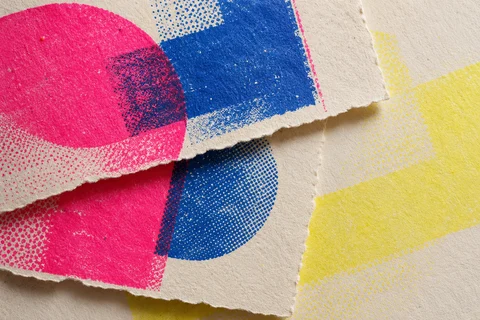
From a reference / Risograph Ephemera
How much repetition does this composition need?
Choose a rhythm deliberately.
Explore the connection & keep your decisions
The printed-paper system offers a context for marks and negative space. Use a pattern family as a starting structure, then make the spacing your own.
What this experiment representsThe pattern is a procedural composition. A named family is a starting reference, not a claim to reproduce every use or meaning of an ornament.
Read the study and its source notesTry one considered change.
- Keep the family and seed fixed; record a sparse impression.
- Increase density without changing the marks.
- Compare at a useful output scale. Keep enough space for anything the pattern will sit behind.
Your judgement / optional
Keep the reason with the result.
Notes stay on this device when saved. Copying a study link includes them. The reference guides your thinking; choosing it does not apply a palette.
The seed, family and locked inks travel with the link; no source-image rights are changed by exporting a pattern.
Choose a family and proof its rhythm at a useful scale.
The Pattern Press
Four families whose marks are inked from the archive’s own tokens, so a sheet re-inks when the site transmutes instead of carrying a palette of its own. Press Space for a new sheet, C to re-ink, S to re-cut.
Keep one. Try another.
Pin a plate before changing the controls. Each pin keeps its own recipe and lighting context.
Carry this specimen into another tool
The image travels locally in this tab with its source recipe. This is a flattened plate: the destination does not recreate fluid motion or convert material coefficients.
Keep the reference and your decisions
Download the starting reference, current settings and your decision notes alongside your specimen. Add notes in the reference panel.