The Registration
Table.
Three inks. One impression.
Move the plates apart and discover what happens between the colours.
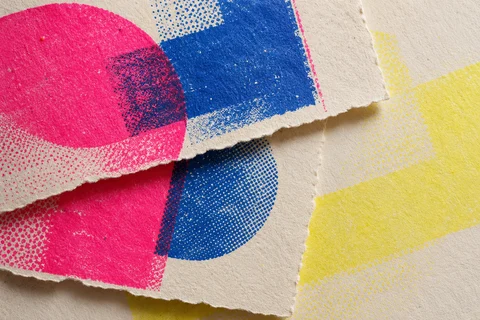
From a reference / Risograph Ephemera
When does misalignment add character, and when does it obscure the image?
Give variation a purpose.
Explore the connection & keep your decisions
The system’s overprinted paper is a visual reference for separate ink layers. Use the plate controls to decide how much separation your composition can carry.
What this experiment representsThe plates are authored digital shapes and compositing effects, not a calibrated press or a reproduction of a historical print.
Read the study and its source notesTry one considered change.
- Keep the motif and inks fixed; record an aligned print.
- Shift one plate, then change its angle separately.
- Compare where edges become expressive and where the motif becomes hard to read.
Your judgement / optional
Keep the reason with the result.
Notes stay on this device when saved. Copying a study link includes them. The reference guides your thinking; choosing it does not apply a palette.
Settings and SVG plates are portable; printed colour depends on the physical ink and paper.
The overlap is a colour, too.
Turn off two inks to inspect a single plate. Bring them back, align the print, then slowly rotate it. The emerging bands belong to the relationship between marks, rather than to any one layer.
Use the Registration Plate component ↗Screen proof. Paper thinking.
This is an authored SVG study using RGB multiply blending. The paper and three inks stay constant as the surrounding interface changes. It illustrates registration and interference; it does not predict the behaviour of physical pigments on a printing press.
Export a resolution-independent SVG, or share the complete study. Keyboard users can focus the print and use arrow keys; hold Shift for larger steps or press Home to align its position.
Explore pigment mixing next ↗