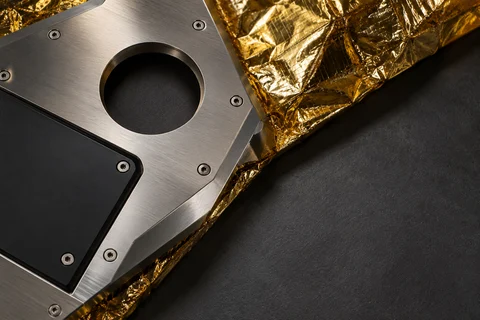
From a reference / Apollo Avionics
How should a control settle after someone lets go?
Let response communicate intent.
Explore the connection & keep your decisions
Apollo Avionics suggests deliberate instrument controls. Explore the analogy through explicit spring parameters rather than assuming a material has one correct feel.
What this experiment representsThe spring equation models motion. Mapping its response to a material or mood is an interpretation, not a physical measurement of an aircraft control.
Read the study and its source notesTry one considered change.
- Keep stiffness and mass fixed; pin a response with higher damping.
- Lower damping and release both responses from the same displacement.
- Compare overshoot and settling. Choose the response that makes the control’s state easiest to follow.
Your judgement / optional
Keep the reason with the result.
Notes stay on this device when saved. Copying a study link includes them. The reference guides your thinking; choosing it does not apply a palette.
The settings restore the spring; a pointer gesture is not a recorded trajectory.
Pull and release the specimen, or release the paired springs below.
Feel the difference.
Choose an intention, pin A, then release both springs together. The same displacement drives the drawer, switch and notification.
The curve uses a 240 Hz numerical spring model. CSS cubic-bezier output is an approximation; it cannot reproduce every oscillation.
Try these kinetics in the state bench →Keep one. Try another.
Pin a plate before changing the controls. Each pin keeps its own recipe and lighting context.
Carry this specimen into another tool
The image travels locally in this tab with its source recipe. This is a flattened plate: the destination does not recreate fluid motion or convert material coefficients.
Keep the reference and your decisions
Download the starting reference, current settings and your decision notes alongside your specimen. Add notes in the reference panel.
Further reading
Questions & notes
A closer look at the ideas, materials and methods behind the work.
Web Audio harmonic feedback, damping coefficients, and kinetic inertia equations.
1 questionAn optional interface sound can reinforce a clearly identified event, such as an acknowledged completion. Gaver’s auditory-icon proposal relates information to everyday sounds; it does not guarantee better performance for this reader. Preserve visible, accessible status in silence, and let the listener decide whether to audition a cue.
Related questions
Unlike rigid CSS ease-in-out bezier curves with fixed durations, spring physics calculate acceleration based on mass, tension (stiffness: 300), and friction (damping: 25). This ensures interactions adapt dynamically to user gesture velocity, making fan blades and drawers feel weighted and physical.
Choose an envelope for the particular cue and test it with listeners in its actual task. Web Audio defines signal timing and gain; it supplies no universally non-fatiguing settings. Chromologium’s monograph exposes three authored sine-tone sketches, an explicit audition and mute/stop controls. Device output level remains uncalibrated.