Drawer I · Vellum & Chalk / F.04
Magnolia.
Ivory, blush and the weight of a shadow.
How does a pale surface become legible without a strong outline?
Magnolia genus editorial study; illustrated forms span species and cultivars and do not document one specimen. Six illustrated colour forms plus stage studies.

01 / Observe
What gives white its depth?.
Authored screen palette sampled from the Ivory & blush illustration and named in perceptual OKLCH space; click any swatch to copy its hex value.
Three places to look
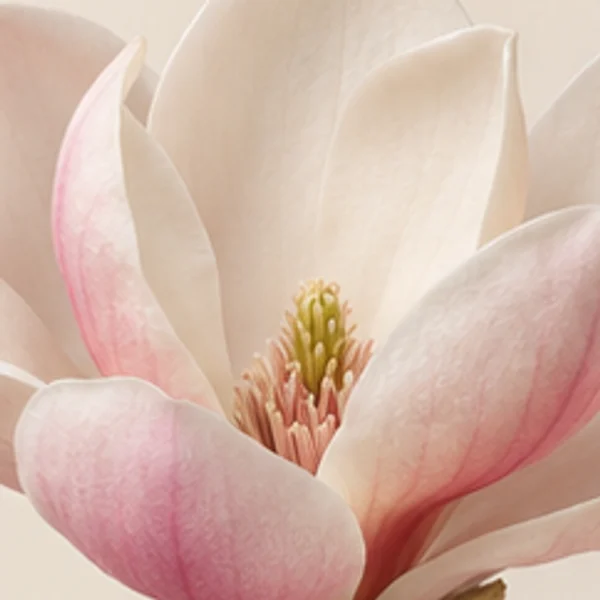
Magnolia’s petal-like parts are called tepals where sepals and petals are not clearly differentiated. Their overlapping faces make shadow part of the colour study.
Numerous stamens occupy the lower part of the flower’s central axis. Look for a fine band of detail inside the broader tepal surfaces.
The female parts form a central group of separate carpels above the stamens. Their compact arrangement gives the flower a different texture at its centre.
02 / Colour forms
The same flower, another relationship.
Keep the composition still. Change the colour relationship.
Ivory & blush
Fade and press return to the default colour form. These are imagined stages, not a recorded time series.

In A (Ivory & blush), field #ece0d4 and ink #86543c read at 4.8:1 text contrast; in B (Pure ivory), field #efe7dd and ink #6b5132 read at 6.0:1.
Both columns use the same proportions and role positions. The six values are sampled from each editorial illustration; they are not measured flower pigments.
03 / Colour & time
What survives the bloom?
A pale flower gives us a demanding subject. Its divisions may be carried by curvature, overlap, and shadow as much as by differences in hue. The Arnold Arboretum describes magnolia flowers through their tepals and their varied star and cup forms. That vocabulary directs attention toward the way the parts occupy space.
In the illustrated study, follow one pale surface from its lit edge toward the place where it turns away. Compare the inner and outer faces. A restrained palette can still contain a broad range of relationships: warm and cool, exposed and sheltered, smooth and folded. These observations belong to the image and viewing conditions before us.
Translate the flower into contrasting architectural surfaces. Let translucent blush onyx, champagne silk velvet, and dark burl wood retain their own character rather than flattening into one uniform tone. Give a boundary enough contrast to be read, then let curvature and sheen do the rest. The exercise is to make the composition’s structure visible through proportion, spacing, and a small number of carefully chosen differences.
- Arnold Arboretum of Harvard University — Early to evolve, early to flower
- Royal Horticultural Society — How to grow magnolias
- Royal Botanic Gardens, Kew — Magnoliaceae Juss.
How does a pale surface become legible without a strong outline?
Select a stage to inspect its sampled OKLCH lightness and chroma shift. Bloom, fade and press are editorial studies of changing appearance for the default form, not a recorded botanical time series.
04 / From flower to material
Magnolia, translated into surface.
An imagined architectural salon and tactile material study of the default ivory & blush form.


- 01Blush banded onyx
- Translucent rose-ivory stone holding raking light.
#e2c5bd - 02Champagne silk velvet
- Luminous pale pile where curvature creates shadow.
#ece0d2 - 03Bordeaux mohair
- Deep mulberry weight drawn from the base of the tepals.
#67293b - 04Espresso burl & brass
- Glossy dark wood framing pale surfaces without outline.
#46291d
05 / Try the palette
Carry it into your own work.
Give each colour a role.
Assign a field, reading ink and accent. Both the composition preview and the A/B comparison update together.
Ratios compare the chosen field and ink only. Other states and components need their own checks.
Set the proportions.
Shares rebalance to 100%. They describe palette allocation, not pigment mixing.
An exercise in looking
A quieter
kind of colour.
A generous field, a deliberate accent, and enough space to see the relationship between them.
01 / Observe
Look for the edge.
02 / Translate
Keep the relationship.
Foliage, seedheads & vessels
Companion bridge tones
Test a stem, dried pod, or vessel finish as the live accent beside magnolia, or copy its hex.
Keep the encounter / Ivory & blush
Keep the encounter.
Save this selection, its proportions and your curatorial note—or export a vertical 2:3 Moody Folio Pin with circular hairline-rimmed medallions for boards and decks.
Moody Folio Pin Studio (1000 × 1500 .png)
Renders the active Magnolia specimen in Specimen & Medallions layout with circular hairline-rimmed medallions, perceptual OKLCH coordinates, and Chromologium colophon at 2:3 ratio.
Notes stay in your saved study and downloaded files. Shared links contain visual settings only.
Across the Chromologium
Follow the inquiry beyond the herbarium.
Connect floral appearance to lexicon essays, historical pigment monographs, design systems, and live optical tools preloaded with magnolia.
Patina & senescence
Follow how living sepals, unlacquered brass, and pressed petals shift chroma over time.
Lexicon · Epistemic scopeProvenance & evidence
Why Chromologium separates cited botanical anatomy from editorial colour interpretation.
Lexicon · Material carryoverSurface translation
How proportion survives when a petal fold becomes silk velvet, veined stone, or paper.
Archive · Pigment historyPigment monographs
Compare botanical lakes, mineral earths, and historical colourants beside floral palettes.
Lab · Structural lightOptics & scattering
Carry your selected screen swatch into a glass-dispersion comparison. This experiment does not model flower tissue.
Lab · Perceptual spaceFormulation workbench
Test sampled hex values for perceptual OKLCH spacing, balance, and contrast behaviour.
Sources & interpretation
Keep the source beside the colour.
Magnolia genus editorial study; illustrated forms span species and cultivars and do not document one specimen. Colours are sampled from editorial illustrations, not measured living flowers. Bloom, fade and press are imagined stages, not a documented time series. The room and material plate translate the default form; they do not change with the colour selector.
F.04 · Magnolia — botanical and optical reading
Publication credit: The Chromologium. Image rights & permissions · Image and palette record