Drawer II · Obsidian & Velvet / F.09
Calla Lily.
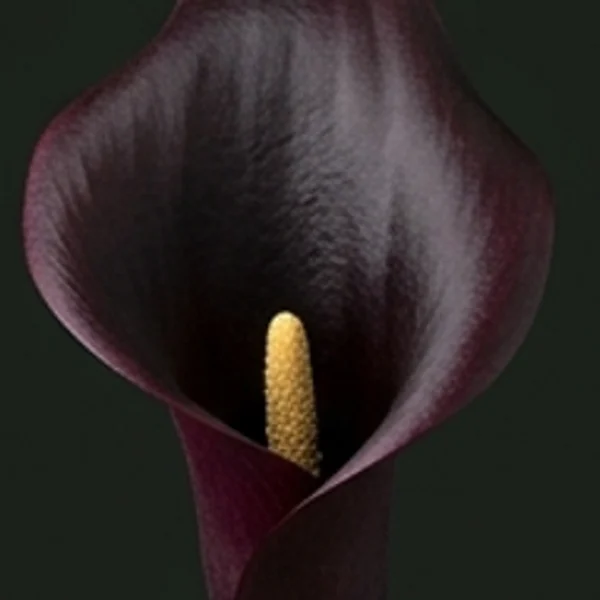
A single spiral spathe, sculpted by raking sheen.
How can a single rolled surface generate an entire tonal scale?
Zantedeschia hybrid-inspired editorial forms on a dark slate ground; no cultivar identification. Six illustrated colour forms plus stage studies.

01 / Observe
One continuous curve.
Authored screen palette sampled from the Aubergine black illustration and named in perceptual OKLCH space; click any swatch to copy its hex value.
Three places to look
The recurved outer margin catches grazing light first, defining the silhouette against dark slate.
Where the bract overlaps itself near the base, trapped shadow deepens plum and garnet tones toward black.
The upright central spike carries minute flowers and introduces a granular, matte column inside the smooth spathe.
02 / Colour forms
The same flower, another relationship.
Keep the composition still. Change the colour relationship.
Aubergine black
Fade and press return to the default colour form. These are imagined stages, not a recorded time series.

In A (Aubergine black), field #150b0b and ink #998f34 read at 5.8:1 text contrast; in B (Garnet wine), field #1c0506 and ink #935a64 read at 3.6:1.
Both columns use the same proportions and role positions. The six values are sampled from each editorial illustration; they are not measured flower pigments.
03 / Colour & time
What survives the bloom?
What we read as a calla lily’s flower is a spathe—a modified leaf bract wrapped in a tight funnel around a central finger-like spadix bearing tiny true flowers. Missouri Botanical Garden and Kew both emphasise this bract-and-spadix architecture across Zantedeschia. Because there are no separate petals to break the plane, colour transitions must travel smoothly across one continuous scroll.
Follow the spathe from its pale or bronze outer throat up to the flared lip and down into the shadowed interior hollow. Even in monochrome aubergine or ivory forms, the spiral cone manufactures three distinct zones: specular rim, mid-tone roll, and deep interior chamber.
Translate that sculptural economy into high-gloss aubergine lacquer, fluted Rosso Levanto marble, and moss silk mohair. When forms are simple and continuous, sheen contrast between satin silk, honed stone, and patinated bronze takes over the work ordinarily done by ornament.
- Missouri Botanical Garden — Zantedeschia aethiopica and hybrid callas
- Royal Botanic Gardens, Kew — Zantedeschia Spreng.
How can a single rolled surface generate an entire tonal scale?
Select a stage to inspect its sampled OKLCH lightness and chroma shift. Bloom, fade and press are editorial studies of changing appearance for the default form, not a recorded botanical time series.
04 / From flower to material
Calla Lily, translated into surface.
An imagined architectural salon and tactile material study of the default aubergine black form.


- 01Aubergine lacquer & satin
- Continuous specular roll across dark purple planes.
#3f1c2e - 02Rosso Levanto marble
- Wine-red stone veined with chalk white and serpentine.
#6d232c - 03Chartreuse-moss mohair
- Acid-botanical seating tone bridging stem and spathe.
#6f7d3c - 04Patinated bronze
- Matte dark metal echoing the central spadix.
#5a4635
05 / Try the palette
Carry it into your own work.
Give each colour a role.
Assign a field, reading ink and accent. Both the composition preview and the A/B comparison update together.
Ratios compare the chosen field and ink only. Other states and components need their own checks.
Set the proportions.
Shares rebalance to 100%. They describe palette allocation, not pigment mixing.
An exercise in looking
A quieter
kind of colour.
A generous field, a deliberate accent, and enough space to see the relationship between them.
01 / Observe
Look for the edge.
02 / Translate
Keep the relationship.
Foliage, seedheads & vessels
Companion bridge tones
Test a stem, dried pod, or vessel finish as the live accent beside calla lily, or copy its hex.
Keep the encounter / Aubergine black
Keep the encounter.
Save this selection, its proportions and your curatorial note—or export a vertical 2:3 Moody Folio Pin with circular hairline-rimmed medallions for boards and decks.
Moody Folio Pin Studio (1000 × 1500 .png)
Renders the active Calla Lily specimen in Specimen & Medallions layout with circular hairline-rimmed medallions, perceptual OKLCH coordinates, and Chromologium colophon at 2:3 ratio.
Notes stay in your saved study and downloaded files. Shared links contain visual settings only.
Across the Chromologium
Follow the inquiry beyond the herbarium.
Connect floral appearance to lexicon essays, historical pigment monographs, design systems, and live optical tools preloaded with calla lily.
Patina & senescence
Follow how living sepals, unlacquered brass, and pressed petals shift chroma over time.
Lexicon · Epistemic scopeProvenance & evidence
Why Chromologium separates cited botanical anatomy from editorial colour interpretation.
Lexicon · Material carryoverSurface translation
How proportion survives when a petal fold becomes silk velvet, veined stone, or paper.
Archive · Pigment historyPigment monographs
Compare botanical lakes, mineral earths, and historical colourants beside floral palettes.
Lab · Structural lightOptics & scattering
Carry your selected screen swatch into a glass-dispersion comparison. This experiment does not model flower tissue.
Lab · Perceptual spaceFormulation workbench
Test sampled hex values for perceptual OKLCH spacing, balance, and contrast behaviour.
Sources & interpretation
Keep the source beside the colour.
Zantedeschia hybrid-inspired editorial forms on a dark slate ground; no cultivar identification. Colours are sampled from editorial illustrations, not measured living flowers. Bloom, fade and press are imagined stages, not a documented time series. The room and material plate translate the default form; they do not change with the colour selector.
F.09 · Calla Lily — botanical and optical reading
Publication credit: The Chromologium. Image rights & permissions · Image and palette record