Drawer III · Silk, Lacquer & Salon / F.13
Peony.
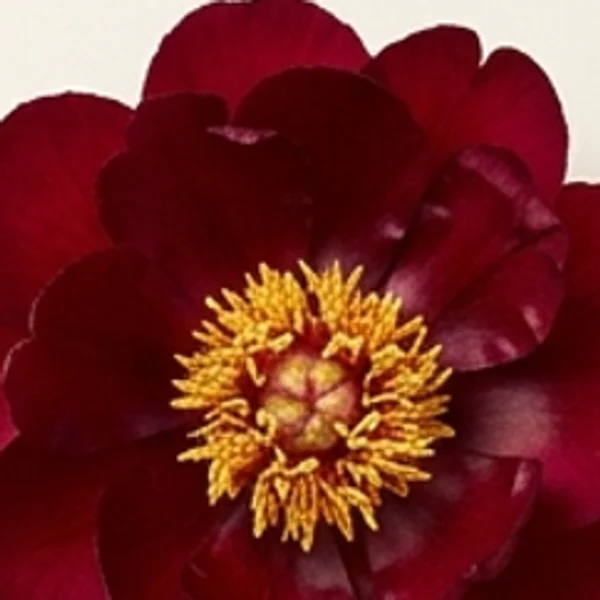
Glossy guard shells cupping a boss of spun gold.
How do broad outer shells hold an unruly interior together?
Paeonia lactiflora, intersectional, and tree peony-inspired editorial forms on archival vellum; no cultivar identification. Six illustrated colour forms plus stage studies.

01 / Observe
Guard petals and gold.
Authored screen palette sampled from the Claret & gold illustration and named in perceptual OKLCH space; click any swatch to copy its hex value.
Three places to look
Rounded outer petals cup the bloom and often bleach or warm first along their exposed rims.
Central stamens—or narrow ruffled petaloids derived from them—introduce contrasting gold or dense inner shadow.
In woody tree peony forms, darker plum-garnet flares anchor the base of translucent ochre or blush petals.
02 / Colour forms
The same flower, another relationship.
Keep the composition still. Change the colour relationship.
Claret & gold
Fade and press return to the default colour form. These are imagined stages, not a recorded time series.

In A (Claret & gold), field #f1ede1 and ink #4a0307 read at 13.7:1 text contrast; in B (Coral sunset), field #f3ecdf and ink #d65328 read at 3.5:1.
Both columns use the same proportions and role positions. The six values are sampled from each editorial illustration; they are not measured flower pigments.
03 / Colour & time
What survives the bloom?
Botanical and horticultural descriptions from the American Peony Society classify peony flower forms from single and semi-double through bomb and full double according to the progressive transformation of stamens into petaloids. Even when the interior erupts into ruffled silk crêpe or golden anthers, broad outer guard petals supply the containing bowl.
Trace the colour temperature shift across coral and claret studies. Semi-double claret forms pit glossy, near-garnet guard shells directly against a dense boss of yellow stamens; coral hybrids famously oxidise from saturated salmon-rose toward apricot-parchment along their outer rims before petals fall.
In salon translation, pair glossy claret lacquer and Breccia Capraia marble with coral-ochre silk velvet and unlacquered brass. Let the brass and ochre carry the stamen warmth in disciplined linear proportions rather than competing with the crimson field.
- American Peony Society — Peony flower forms and classification
- Royal Botanic Gardens, Kew — Paeonia L.
How do broad outer shells hold an unruly interior together?
Select a stage to inspect its sampled OKLCH lightness and chroma shift. Bloom, fade and press are editorial studies of changing appearance for the default form, not a recorded botanical time series.
04 / From flower to material
Peony, translated into surface.
An imagined architectural salon and tactile material study of the default claret & gold form.


- 01Claret silk velvet
- Broad guard-petal crimson with deep inner fold.
#731c2c - 02Coral-apricot raw silk
- Oxidising salmon-to-champagne outer petal shift.
#d9826c - 03Calacatta Viola marble
- Cream breccia veined in cabernet and plum.
#eadfd4 - 04Burl walnut & brass
- Spun stamen gold held in architectural hardware.
#b88b3c
05 / Try the palette
Carry it into your own work.
Give each colour a role.
Assign a field, reading ink and accent. Both the composition preview and the A/B comparison update together.
Ratios compare the chosen field and ink only. Other states and components need their own checks.
Set the proportions.
Shares rebalance to 100%. They describe palette allocation, not pigment mixing.
An exercise in looking
A quieter
kind of colour.
A generous field, a deliberate accent, and enough space to see the relationship between them.
01 / Observe
Look for the edge.
02 / Translate
Keep the relationship.
Foliage, seedheads & vessels
Companion bridge tones
Test a stem, dried pod, or vessel finish as the live accent beside peony, or copy its hex.
Keep the encounter / Claret & gold
Keep the encounter.
Save this selection, its proportions and your curatorial note—or export a vertical 2:3 Moody Folio Pin with circular hairline-rimmed medallions for boards and decks.
Moody Folio Pin Studio (1000 × 1500 .png)
Renders the active Peony specimen in Specimen & Medallions layout with circular hairline-rimmed medallions, perceptual OKLCH coordinates, and Chromologium colophon at 2:3 ratio.
Notes stay in your saved study and downloaded files. Shared links contain visual settings only.
Across the Chromologium
Follow the inquiry beyond the herbarium.
Connect floral appearance to lexicon essays, historical pigment monographs, design systems, and live optical tools preloaded with peony.
Patina & senescence
Follow how living sepals, unlacquered brass, and pressed petals shift chroma over time.
Lexicon · Epistemic scopeProvenance & evidence
Why Chromologium separates cited botanical anatomy from editorial colour interpretation.
Lexicon · Material carryoverSurface translation
How proportion survives when a petal fold becomes silk velvet, veined stone, or paper.
Archive · Pigment historyPigment monographs
Compare botanical lakes, mineral earths, and historical colourants beside floral palettes.
Lab · Structural lightOptics & scattering
Carry your selected screen swatch into a glass-dispersion comparison. This experiment does not model flower tissue.
Lab · Perceptual spaceFormulation workbench
Test sampled hex values for perceptual OKLCH spacing, balance, and contrast behaviour.
Sources & interpretation
Keep the source beside the colour.
Paeonia lactiflora, intersectional, and tree peony-inspired editorial forms on archival vellum; no cultivar identification. Colours are sampled from editorial illustrations, not measured living flowers. Bloom, fade and press are imagined stages, not a documented time series. The room and material plate translate the default form; they do not change with the colour selector.
F.13 · Peony — botanical and optical reading
Publication credit: The Chromologium. Image rights & permissions · Image and palette record