Drawer III · Silk, Lacquer & Salon / F.14
Ranunculus.
Wafer-thin concentric layers with an inner glaze.
Why do tightly packed translucent layers glow from within?
Ranunculus asiaticus-inspired editorial forms on archival vellum; no cultivar identification. Six illustrated colour forms plus stage studies.

01 / Observe
Wafer-thin gloss.
Authored screen palette sampled from the Burnt amber illustration and named in perceptual OKLCH space; click any swatch to copy its hex value.
Three places to look
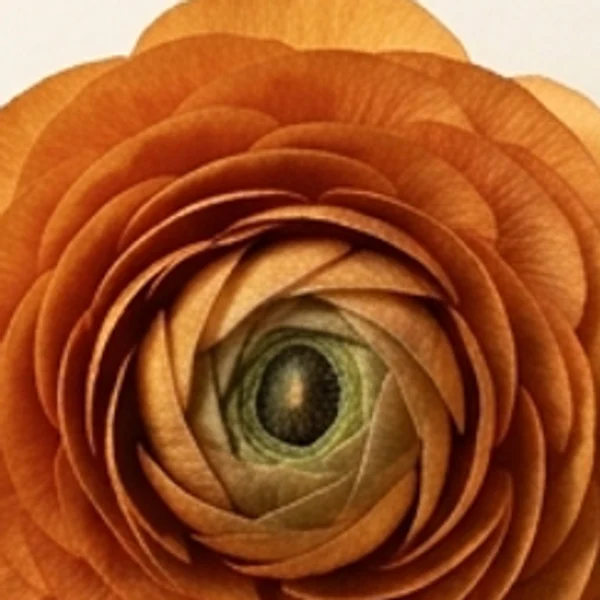
Tightly imbricated petals form a dense rose-like spiral whose fine edges read like contour lines.
Several cultivated forms concentrate plum or rose pigment along the extreme rim of each pale or amber petal.
A compact dark olive or espresso cone sits deep in the vortex, emerging clearly during senescence.
02 / Colour forms
The same flower, another relationship.
Keep the composition still. Change the colour relationship.
Burnt amber
Fade and press return to the default colour form. These are imagined stages, not a recorded time series.

In A (Burnt amber), field #f4ecdf and ink #64230a read at 10.0:1 text contrast; in B (Espresso plum), field #f3ede1 and ink #150907 read at 16.8:1.
Both columns use the same proportions and role positions. The six values are sampled from each editorial illustration; they are not measured flower pigments.
03 / Colour & time
What survives the bloom?
Buttercup relatives frequently exhibit a mirror-like gloss caused by a smooth, starch-backed or air-layered epidermis that reflects specular light while scattering warm pigment underneath. In garden ranunculus (Ranunculus asiaticus), that thin glazed membrane is multiplied across dozens of concentric, paper-fine petals spiralling around a dark green or plum receptacle.
Examine the burnt-amber and picotee studies closely. Because each petal is barely thicker than tissue, light passes through outer rims and bounces back from underlying layers, warming the creases between petals rather than greying them out. Only when the flower ages and opens wide does the dark central cone claim prominence.
Translate that luminous layering into cinnabar Venetian plaster, amber silk satin, smoked Murano glass, and green-veined marble. High-sheen textiles beside matte plaster recreate the contrast between glazed petal curves and papery dry edges.
- Vignolini, S. et al. — Directional scattering from the glossy flower of Ranunculus: how the buttercup lights up your chin
- Royal Horticultural Society — Ranunculus asiaticus
Why do tightly packed translucent layers glow from within?
Select a stage to inspect its sampled OKLCH lightness and chroma shift. Bloom, fade and press are editorial studies of changing appearance for the default form, not a recorded botanical time series.
04 / From flower to material
Ranunculus, translated into surface.
An imagined architectural salon and tactile material study of the default burnt amber form.


- 01Burnt-amber silk satin
- Mirror-glazed buttercup sheen in warm terracotta.
#c86d3b - 02Cinnabar Venetian plaster
- Trowelled mineral warmth with translucent depth.
#b83c28 - 03Green-and-gold marble
- Pistachio and olive veining from the tight eye.
#6d7d45 - 04Smoked Murano & walnut
- Refracted amber glass beside espresso cone shadow.
#4b3222
05 / Try the palette
Carry it into your own work.
Give each colour a role.
Assign a field, reading ink and accent. Both the composition preview and the A/B comparison update together.
Ratios compare the chosen field and ink only. Other states and components need their own checks.
Set the proportions.
Shares rebalance to 100%. They describe palette allocation, not pigment mixing.
An exercise in looking
A quieter
kind of colour.
A generous field, a deliberate accent, and enough space to see the relationship between them.
01 / Observe
Look for the edge.
02 / Translate
Keep the relationship.
Foliage, seedheads & vessels
Companion bridge tones
Test a stem, dried pod, or vessel finish as the live accent beside ranunculus, or copy its hex.
Keep the encounter / Burnt amber
Keep the encounter.
Save this selection, its proportions and your curatorial note—or export a vertical 2:3 Moody Folio Pin with circular hairline-rimmed medallions for boards and decks.
Moody Folio Pin Studio (1000 × 1500 .png)
Renders the active Ranunculus specimen in Specimen & Medallions layout with circular hairline-rimmed medallions, perceptual OKLCH coordinates, and Chromologium colophon at 2:3 ratio.
Notes stay in your saved study and downloaded files. Shared links contain visual settings only.
Across the Chromologium
Follow the inquiry beyond the herbarium.
Connect floral appearance to lexicon essays, historical pigment monographs, design systems, and live optical tools preloaded with ranunculus.
Patina & senescence
Follow how living sepals, unlacquered brass, and pressed petals shift chroma over time.
Lexicon · Epistemic scopeProvenance & evidence
Why Chromologium separates cited botanical anatomy from editorial colour interpretation.
Lexicon · Material carryoverSurface translation
How proportion survives when a petal fold becomes silk velvet, veined stone, or paper.
Archive · Pigment historyPigment monographs
Compare botanical lakes, mineral earths, and historical colourants beside floral palettes.
Lab · Structural lightOptics & scattering
Carry your selected screen swatch into a glass-dispersion comparison. This experiment does not model flower tissue.
Lab · Perceptual spaceFormulation workbench
Test sampled hex values for perceptual OKLCH spacing, balance, and contrast behaviour.
Sources & interpretation
Keep the source beside the colour.
Ranunculus asiaticus-inspired editorial forms on archival vellum; no cultivar identification. Colours are sampled from editorial illustrations, not measured living flowers. Bloom, fade and press are imagined stages, not a documented time series. The room and material plate translate the default form; they do not change with the colour selector.
F.14 · Ranunculus — botanical and optical reading
Publication credit: The Chromologium. Image rights & permissions · Image and palette record