Drawer II · Obsidian & Velvet / F.07
Tulip.
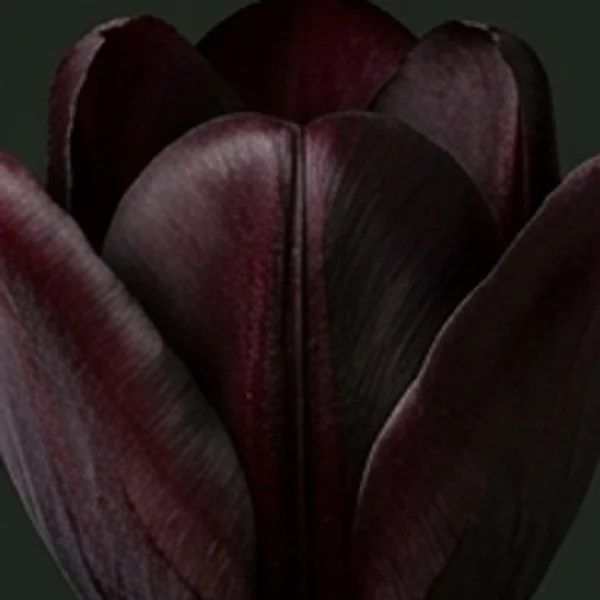
Plum-black chalices and feathered rims on dark slate.
What happens when a flower appears darker than its shadow?
Cultivated Tulipa (Single Late, Parrot, and Lily-flowered group)-inspired editorial forms on a dark slate ground; no cultivar voucher claimed. Six illustrated colour forms plus stage studies.

01 / Observe
Approaching black through plum.
Authored screen palette sampled from the Plum-black illustration and named in perceptual OKLCH space; click any swatch to copy its hex value.
Three places to look
Three outer tepals clasp the base of the cup. Their waxy backs hold a cool directional highlight even on plum-black forms.
Three inner tepals nest slightly inside the outer ring, creating a narrow shadow seam where the two planes overlap.
Opening cups reveal dark anthers and a contrasting basal zone that shifts markedly when the bloom flattens under press.
02 / Colour forms
The same flower, another relationship.
Keep the composition still. Change the colour relationship.
Plum-black
Fade and press return to the default colour form. These are imagined stages, not a recorded time series.

In A (Plum-black), field #0e0504 and ink #665748 read at 2.9:1 text contrast; in B (Parrot flame), field #181d17 and ink #d36b54 read at 4.9:1.
Both columns use the same proportions and role positions. The six values are sampled from each editorial illustration; they are not measured flower pigments.
03 / Colour & time
What survives the bloom?
Botanical breeders have pursued a true black tulip for centuries without eliminating hue. As the Royal Horticultural Society notes in its accounts of dark Single Late tulips, even the deepest chalices remain dense concentrations of violet and crimson pigment rather than pure carbon black. Under raking light, their curved tepals confess a plum or burgundy undertone.
Set against a dark forest-slate ground rather than pale herbarium paper, the tulip’s silhouette stops relying on stark outline and begins to work by specular sheen. Follow the outer tepal’s waxy midrib from the stem junction up to the rounded rim. Notice how parrot feathering or lily-pointed tips change the pace at which light leaves the cup.
In architectural translation, pair near-black silk velvet with ebonized oak burl and veined green Verde Antico stone so darkness reads as layered material depth rather than an empty void. Reserve warm alabaster or brushed copper for a narrow highlight that lets the eye measure the surrounding dark.
- Royal Horticultural Society — Tulips: growing guide and horticultural divisions
- Royal Botanic Gardens, Kew — Tulipa L.
What happens when a flower appears darker than its shadow?
Select a stage to inspect its sampled OKLCH lightness and chroma shift. Bloom, fade and press are editorial studies of changing appearance for the default form, not a recorded botanical time series.
04 / From flower to material
Tulip, translated into surface.
An imagined architectural salon and tactile material study of the default plum-black form.


- 01Plum-black silk velvet
- Dense nocturnal pile echoing the outer chalice.
#2d1628 - 02Verde Antico marble
- Serpentine green stone drawn from the fleshy stem.
#2d4c3b - 03Ebonized oak burl
- Charcoal swirled timber grounding the dark field.
#28211e - 04Smoked topaz & copper
- Warm translucent refraction against dark boiserie.
#b5723c
05 / Try the palette
Carry it into your own work.
Give each colour a role.
Assign a field, reading ink and accent. Both the composition preview and the A/B comparison update together.
Ratios compare the chosen field and ink only. Other states and components need their own checks.
Set the proportions.
Shares rebalance to 100%. They describe palette allocation, not pigment mixing.
An exercise in looking
A quieter
kind of colour.
A generous field, a deliberate accent, and enough space to see the relationship between them.
01 / Observe
Look for the edge.
02 / Translate
Keep the relationship.
Foliage, seedheads & vessels
Companion bridge tones
Test a stem, dried pod, or vessel finish as the live accent beside tulip, or copy its hex.
Keep the encounter / Plum-black
Keep the encounter.
Save this selection, its proportions and your curatorial note—or export a vertical 2:3 Moody Folio Pin with circular hairline-rimmed medallions for boards and decks.
Moody Folio Pin Studio (1000 × 1500 .png)
Renders the active Tulip specimen in Specimen & Medallions layout with circular hairline-rimmed medallions, perceptual OKLCH coordinates, and Chromologium colophon at 2:3 ratio.
Notes stay in your saved study and downloaded files. Shared links contain visual settings only.
Across the Chromologium
Follow the inquiry beyond the herbarium.
Connect floral appearance to lexicon essays, historical pigment monographs, design systems, and live optical tools preloaded with tulip.
Patina & senescence
Follow how living sepals, unlacquered brass, and pressed petals shift chroma over time.
Lexicon · Epistemic scopeProvenance & evidence
Why Chromologium separates cited botanical anatomy from editorial colour interpretation.
Lexicon · Material carryoverSurface translation
How proportion survives when a petal fold becomes silk velvet, veined stone, or paper.
Archive · Pigment historyPigment monographs
Compare botanical lakes, mineral earths, and historical colourants beside floral palettes.
Lab · Structural lightOptics & scattering
Carry your selected screen swatch into a glass-dispersion comparison. This experiment does not model flower tissue.
Lab · Perceptual spaceFormulation workbench
Test sampled hex values for perceptual OKLCH spacing, balance, and contrast behaviour.
Sources & interpretation
Keep the source beside the colour.
Cultivated Tulipa (Single Late, Parrot, and Lily-flowered group)-inspired editorial forms on a dark slate ground; no cultivar voucher claimed. Colours are sampled from editorial illustrations, not measured living flowers. Bloom, fade and press are imagined stages, not a documented time series. The room and material plate translate the default form; they do not change with the colour selector.
F.07 · Tulip — botanical and optical reading
Publication credit: The Chromologium. Image rights & permissions · Image and palette record