 CHNAsia
China
Dougong & Feng Shui Harmonization
Colour, piece by piece.
Lacquered nanmu wood & imperial yellow glazed tile
Follow the rhythm of individual surfaces, then see how the palette holds them together.
Material & Chromatic Spectrum
Calibrated OkLCH color science mapped from historical mineral pigments, architectural substrates, and intaglio inks.
Imperial Vermilion
#DE2910
oklch(0.53 0.22 35)
The colour stays fixed as its surroundings change.
Dynamic Component Diorama
Real-time rendering of interactive UI primitives styled with China's sovereign design tokens.
Dougong & Feng Shui Harmonization
Tactile surface responding with 0.14 optical friction and critically damped (crisp) kinetics.
From Physical Lineage to Digital Space
“The joint that yields outlasts the stone that resists; hierarchy is harmony made visible.”
Chinese architectural engineering achieved monumental permanence not through rigid stone mortar, but through the interlocking wooden joint (dougong) that absorbs seismic shocks. This philosophy of interlocking modularity with structural flexibility is the ancient counterpart to headless component APIs, decoupled state management, and resilient fault-tolerant design tokens.

Forbidden City
The world's largest palatial complex — post-and-beam dougong bracket architecture, axial symmetry, and color-coded hierarchy mapping cosmic sovereignty.
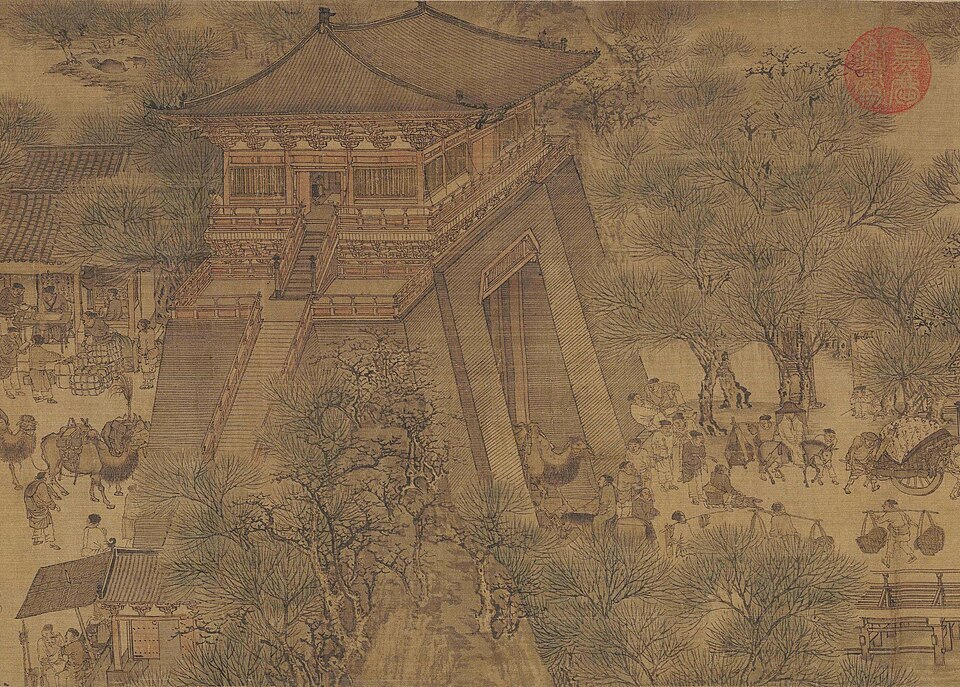
Along the River During the Qingming Festival
The primary compositional study embodying China's national color philosophy, surface chemistry, and aesthetic tension.
China in the Global Material Cartography
Spatial provenance, trade route vectors, solar diurnal phase, and localized craft beacons across China.
Regional Craft Hubs & Historical Cities
Granular material lineages, landmark architecture, and specialized regional craft centers across China.
Monumental imperial dougong bracket architecture constructed entirely without nails to absorb earthquakes while projecting cosmic order.
The world capital of porcelain for over a millennium, firing purified kaolin stone at 1300°C into vitrified, translucent white bodies.
Intimate courtyard garden architecture using whitewashed walls, black eaves, and water reflections to compress entire landscapes into micro-space.
Ancient Buddhist cave frescoes preserving brilliant raw lapis lazuli, malachite, and gold leaf imported across Eurasian caravan trails.
A hybrid architectural vernacular fusing European neoclassical stone carvings with traditional Jiangnan courtyard living.
Sensory Specifications & Surface Friction
CULTURAL ACOUSTIC LINEAGE & PROVENANCE
The 433 BC Zeng Hou Yi Bianzhong chime bells represent the pinnacle of ancient acoustic engineering: almond-shaped bronze casting allowing each bell to produce two distinct musical pitches depending on strike location. Combined with silk-stringed Guqin harmonics, Chinese acoustics emphasize the philosophical resonance of stone, metal, and silk (Bayin system).
PSYCHOACOUSTIC & COGNITIVE PROFILE
494 Hz (B4) resonant chime, fostering contemplative equilibrium, harmonic patience, and natural balance.
DIGITAL UI TRANSLATION SPEC
Synthesized live via the browser's Web Audio API with exponential gain decay and fifth-harmonic overtone dispersion to provide tactile, non-speech micro-interaction feedback.
Connected Systems & Lexicon Axioms
“China: Design Provenance & Material Spectrum.” The Chromologium — Design Atlas, 2026. chromologium.com/atlas/china
Follow the surface.
Another place to explore glaze & repetition. These connections group the archive by material, alongside its geographic routes.
Related Sovereign Traditions






Cartographic Inquiries: China
Architectural traditions, material physics, acoustic earcons, and living design tokens of China.